The Legal Fight to Make Corporations Cover Climate Losses | Atmos
https://atmos.earth/the-legal-fight-to-make-corporations-cover-climate-losses/
File under: “treat disasters like a rear-end auto accident,” or “natural disastrers are no longer acts of god.
09.09.2025
Words by Nicole Abriam
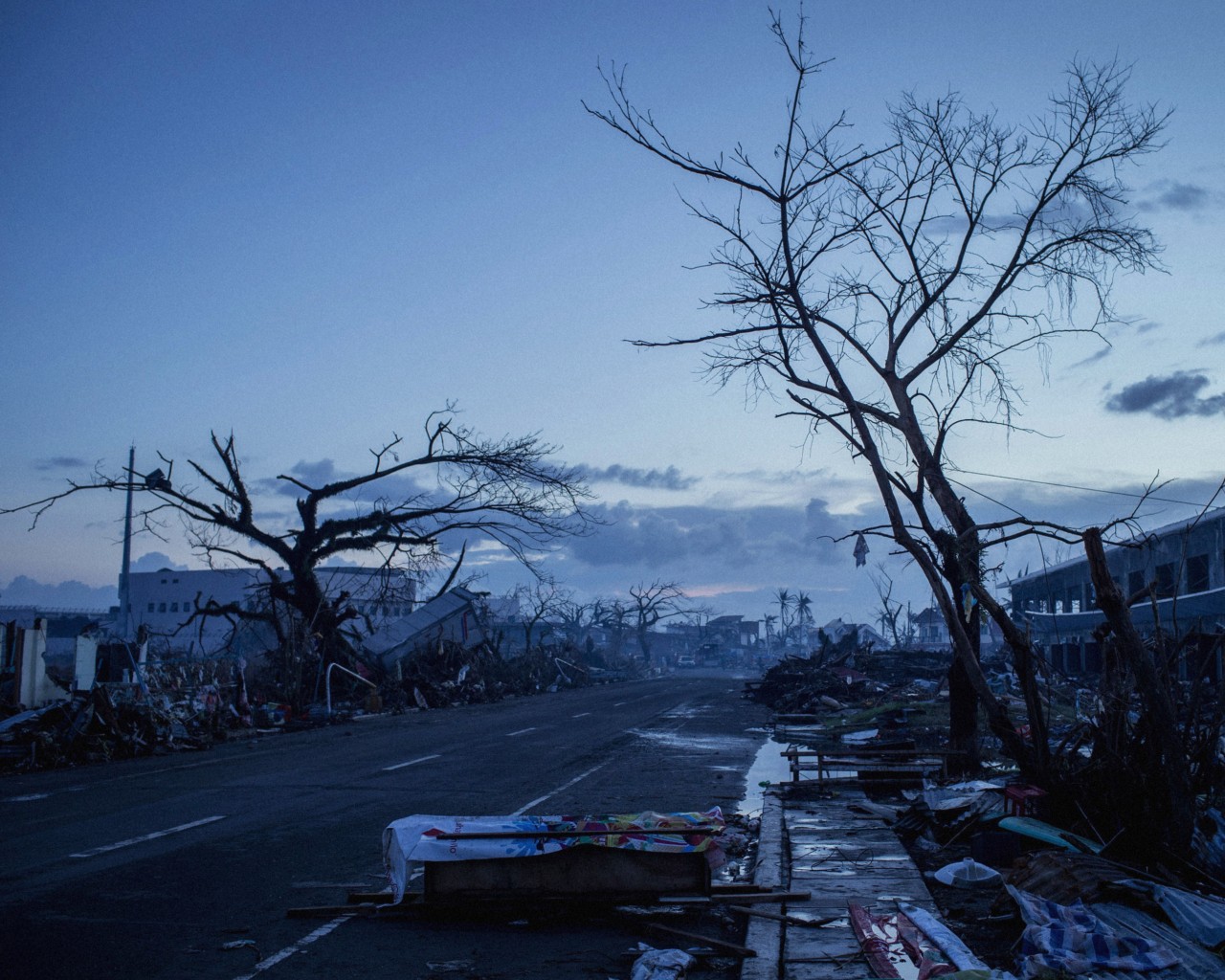
Photograph by Chris McGrath / Getty Images
The Philippines has introduced the world’s first climate reparations bill, a test case for making fossil fuel giants cover the costs of disaster.
When Typhoon Haiyan tore through the Philippines in November 2013, it killed more than 6,300 people and left over 4 million homeless. The storm’s devastation lingers more than a decade later. With sustained winds reaching 196 miles per hour, Haiyan remains one of the deadliest storms in history and the costliest the Philippines has ever faced, with damages now exceeding $13 billion.
Haiyan is not an outlier. Other disasters have revealed staggering losses and the limits of recovery for frontline communities. The Great East Japan Earthquake and subsequent tsunami in 2011 cost an estimated $220 billion, making it the most expensive natural disaster in history. Just a few years earlier, Hurricane Katrina inflicted $135 billion in losses across the United States. Over the past two decades alone, climate disasters have caused an estimated $2.8 trillion in damages, according to the World Economic Forum. By mid-century, that figure could climb up to $3.1 trillion per year—losses that many nations in the Global South simply cannot absorb.
The mounting costs reveal a painful truth. Most countries and communities have for too long had no clear legal pathway to demand compensation for the devastation they’ve endured. But a new global framework for climate reparations could change that, giving frontline communities the tools to recover and creating a mechanism to hold the wealthiest, highest-emitting corporations accountable for the damage they cause.
A First Step Toward Accountability
In the Philippines, CLIMA—short for the Climate Accountability Act—is a first-of-its-kind attempt to do what past petitions could not: turn climate justice into law.
That effort traces back to Typhoon Haiyan. In the two years after the storm, several survivors filed a landmark petition to the Commission of Human Rights. The petition accused major carbon-emitting industries, primarily oil, gas, and coal, of human rights violations and demanded they be held accountable for the effects of climate change that affected communities like those in Tacloban, a city in the Philippines where more than 2,300 people were killed during Haiyan.
That complaint culminated in a groundbreaking 2022 report by the Commission of Human Rights, the first in the world to formally establish a link between climate change and human rights violations. “It’s a very compelling report,” Joy Reyes, a lawyer who works with Friends of the Earth Philippines, told Atmos. “One of its salient provisions was that climate justice is a human rights issue, and that corporations can be held liable for human rights violations. Corporations knew about the climate crisis early on, but refused to take measures to mitigate it.”
“In the Philippines, CLIMA—short for the Climate Accountability Act—is a first-of-its-kind attempt to do what past petitions could not: turn climate justice into law.”
Nicole Abriam, writer
But while precedent-setting, the Commission of Human Rights report carried no legal weight. “It is not legally binding because the Commission of Human Rights is not a court,” said Reyes. “And so Greenpeace, Friends of the Earth Philippines, and Natural Resources Center came together and were like, OK, next step is to draft a bill that would put the report’s findings into a legal policy framework.” The following year, on November 22, 2023, House Bill 9609—otherwise known as the CLIMA bill—was introduced in the Philippine Congress.
CLIMA became the first legislation of its kind to set a legal precedent for holding corporations accountable for their role in the climate crisis and to open the door for communities to seek reparations for the loss and damage they have suffered. The bill is rooted in the “polluter pays” principle: the widely accepted idea that those who cause the damage should bear the costs. Though not yet law, advocates say the bill could transform climate justice in one of the world’s most vulnerable nations and perhaps lay the groundwork for similar frameworks elsewhere as climate change makes every country more exposed.
NASA Response Mappers – GLOBE Observer – GLOBE.gov
https://observer.globe.gov/do-globe-observer/do-more/data-requests/nasa-response-mappers
NASA Disasters are requesting regular observations during the peak hurricane season when hurricane awareness is higher. They ask that NO observations be made during a hurricane or in dangerous conditions, rather periodic observations from August through October. Documentation of no change is also helpful. For the GLOBE data to be impactful, regular (weekly or monthly) observations of a particular location are needed over a wide geographic area.
There are many rich datasets already out there — hwy traffic camers, Ring security cameras, CCTV, … What else?
Key facts about the long-term impacts of extreme weather and disasters
Local officials have a powerful tool to warn residents of emergencies. They don’t always use it – Stocktonia News
Formal reviews after disasters have repeatedly faulted local authorities for not being prepared to send targeted IPAWS alerts — which can broadcast to cellphones, weather radios, and radio and TV stations — or sending them too late or with inadequate guidance
The Letter DHS Can’t Ignore: Lessons From Katrina
https://substack.com/inbox/post/172313166?triedRedirect=true&just_subscribed=true
The signatories outlined six major objections: the continuing reduction of FEMA’s mission capacity, the lack of a legally qualified Administrator, the elimination of mitigation programs, interference with preparedness efforts, censorship of climate science, and the erosion of FEMA’s workforce—all of which risk repeating the mistakes made during Hurricane Katrina’s disaster response.
The Goldilocks rule for sustainable cities: Study reveals the ‘just right’ population
When the government can see everything: How one company – Palantir – is mapping the nation’s data
Regarding my prior work on privacy issues
Trump administration rolls back some post-Katrina changes at FEMA : NPR
Wind isn’t the only threat: Scientists urge shift to more informed hurricane scale
https://phys.org/news/2025-08-isnt-threat-scientists-urge-shift.html
I haven’t argued the need for an advanced scale. I would include a measures such as a. diameter of the wind field, b. amount of total moisture with in the wind field, c. expected increase (/decrease) in next 12hrs

